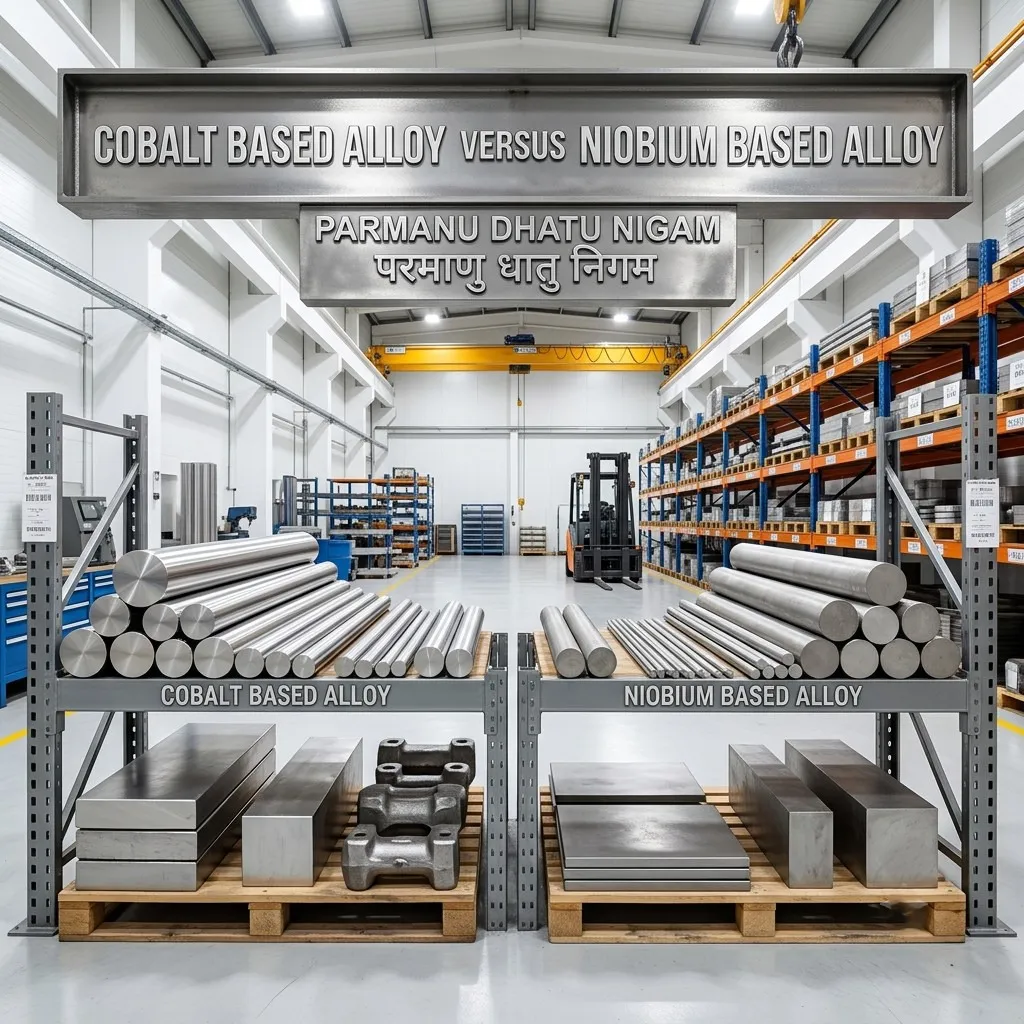
A cobalt alloy and a niobium alloy solve different high-temperature problems: one is usually built for exposed-air wear, corrosion, and thermal cycling, while the other targets extreme temperatures in vacuum or controlled atmospheres. The right choice depends on atmosphere, temperature duration, load, component function, fabrication route, and documentation—not on melting point alone.
Key takeaways
- Choose cobalt alloys for oxidation, erosion, carburising gas, and sliding contact.
- Choose C103 when vacuum or inert gas preserves strength at refractory temperatures.
- Rate the component’s local hot spot, not only the furnace temperature.
- Request heat numbers, chemistry, mechanical data, and joining guidance before purchase.
Choose by atmosphere, temperature duration, and failure mode
Start with a cobalt alloy for equipment exposed continuously to air, combustion gas, carburising gas, erosion, or sliding contact. Start with a niobium alloy when the equipment operates at refractory temperatures in vacuum or inert gas and the main failure risk is loss of strength, not oxidation.
That is the practical answer to cobalt alloy vs niobium alloy.
| Material class | Best starting condition | Main advantage | Main failure risk |
|---|---|---|---|
| Cobalt-based alloy | Air, combustion gas, reducing or carburising service | Hot strength, oxidation resistance, wear resistance, thermal-fatigue resistance | Oxidation, hot corrosion, erosion, or creep under load |
| C103 niobium alloy | Vacuum, high-purity inert gas, or protected hot zones | High-temperature specific strength and low density | Rapid oxidation if exposed bare to hot air |
| C103 with coating or encapsulation | Extreme-temperature service with controlled protection | Extends refractory-temperature capability | Coating cracking, leakage, contamination, or repair damage |
Duration changes the decision. A short excursion above the continuous operating temperature does not make C103 suitable for oxidising gas, and a cobalt alloy’s melting point does not define its safe service temperature.
Check the actual failure mode: choose cobalt for valve seats, dies, nozzles, heater supports exposed to air, and wear strips; choose C103 for vacuum hot-zone hardware where oxidation protection is engineered.
Niobium’s approximately 2,468°C melting point is not a usable equipment temperature. Specify atmosphere, continuous temperature, excursion time, thermal cycling, load, and erosion before approving either class.
C103 and cobalt alloys have different usable temperature envelopes
C103 contains approximately 10% hafnium and 1% titanium, but its melting point is not its operating limit. Continuous service is governed by creep, strength retention, coating life, and atmosphere control; a brief excursion above the qualified temperature does not make bare C103 safe in air.
| Service case | C103 niobium alloy | Cobalt-based alloy |
|---|---|---|
| Continuous service | Strong choice in vacuum or inert gas when the design controls creep and oxidation; use a coating or encapsulation for any oxygen exposure. | Strong choice in air, combustion environments, and hot-corrosive service when the exact UNS grade and product condition are qualified. |
| Short excursion | Acceptable only after checking dwell time, thermal cycling, coating damage, and the recovery of the protective atmosphere. A single air leak can cause rapid oxidation at temperature. | A brief temperature spike can be tolerated within the grade’s validated excursion limit, but repeated spikes accelerate creep, oxidation, grain damage, or thermal fatigue. |
| Atmosphere change | Vacuum or inert gas preserves the intended envelope; air sharply reduces it, while combustion or reducing chemistry requires separate compatibility testing. | Air resistance is a principal advantage, but sulfur-bearing, carburising, reducing, or erosive gases can still cause rapid attack. |
Niobium alloy industrial applications therefore centre on rocket nozzles, combustion chambers, thrusters, and protected aerospace hot structures—not exposed furnace fixtures by default. For cobalt alloys, specify the grade, heat treatment, form, surface condition, and product standard before assigning a continuous or excursion temperature.
Match the alloy to the component, not just the furnace temperature
Furnace fixtures in air, combustion gas, or molten-salt service usually favour cobalt alloys; C103 is a specialised choice for vacuum or controlled inert hot zones. The component’s wear, oxidation, thermal cycling, and repair demands matter more than the furnace’s peak temperature.
| Component | Cobalt-based alloy fit | Niobium-based alloy fit |
|---|---|---|
| Furnace fixtures and heater supports | Strong choice for air exposure, oxidation, creep, and thermal fatigue | Use only in vacuum or protected inert service; oxidation protection becomes a design requirement |
| Thermocouple protection | Practical for air, combustion products, and handling wear | Suitable for extreme-temperature vacuum or inert service with a compatible coating |
| Hot-zone hardware | Better where the part sees air, erosion, salts, or repeated cycling | Better where low density and high-temperature strength outweigh coating and contamination risks |
| Dies and nozzles | Preferable for hot wear, impact, sliding contact, and repairable tooling | Reserve for protected extreme-temperature hardware, such as specialised aerospace nozzles |
| Valve seats and wear strips | Usually the clear choice for galling, erosion, corrosion under load, and dimensional replacement | Poor choice for exposed-air sliding wear unless the environment is tightly controlled |
For C103, coating life, joining route, and recoating logistics can decide the design. A bare niobium alloy component that enters air can oxidise rapidly, while cobalt alloys remain more practical for exposed process equipment.
A search for a cobalt based alloy vs niobium based alloy supplier in tamil nadu should therefore compare available forms, imported-mill traceability, replacement lead time, and minimum order quantity—not only the alloy name.
Plan fabrication, joining, and repair before approving the material
Approve the material only after its cutting, joining, inspection, and repair route has passed a trial on the actual grade. A furnace part that survives service can still fail during fabrication through cracking, distortion, contamination, or an unrepairable weld.
1. Confirm the grade and condition before machining. Cobalt-chromium alloys work-harden and carbide-rich grades rapidly blunt tools; use rigid fixturing, sharp carbide tooling, controlled feeds, and generous coolant where permitted. Niobium alloys demand clean tooling and handling because iron, copper, oil, oxygen, nitrogen, and hydrogen contamination can embrittle the surface.
2. Qualify the joining procedure on representative thicknesses. Niobium requires high-purity inert-gas shielding, protected root and cooling zones, clean joint preparation, and controlled heat input. A discoloured weld is a warning, not a cosmetic defect.
Cobalt alloys need filler selection, preheat and interpass control where specified, and checks for hot cracking, porosity, dilution, and carbide-related brittleness.
3. Design repairs as engineered welds, not site grinding. Identify the crack mechanism, remove all damaged metal, verify the cavity by liquid penetrant or radiography where suitable, and use a qualified procedure with post-weld inspection. Do not weld over carburised, oxidised, salt-contaminated, or work-hardened material.
4. Ask any cobalt based alloy supplier tamil nadu search identifies for weld maps, heat-treatment instructions, mill certificates, and repair limits. For niobium, demand atmosphere and handling controls before accepting a long-lead specialty part.
Compare supplier documentation and installed cost in Tamil Nadu
A Tamil Nadu quotation is incomplete if it names only “cobalt alloy” or “niobium alloy.” Compare the evidence behind performance, delivery, and replacement cost, not the nominal chemistry alone.
| Factor | Cobalt-based alloy | Niobium-based alloy |
|---|---|---|
| Stock and form | More likely in bar, sheet, tube, casting, wear part, or fabricated form; confirm local stock | Often limited to specialist mill forms; confirm import route, minimum order, and replacement lead time |
| Material record | Request exact UNS grade, product standard, heat number, chemistry, condition, dimensions, and EN 10204 3.1 certificate | Request the same records, plus coating type and thickness, atmosphere limits, thermal-cycle data, and repair method |
| Service evidence | Check oxidation, carburisation, erosion, and hot-wear data for the actual grade and component | Demand vacuum or inert-gas limits; bare material is not evidence for oxidising-furnace service |
| Installed cost | Usually lower disruption risk when standard forms are available locally | Include coating, atmosphere control, imported freight, qualification, and long replacement lead time |
Ask the high temperature alloy supplier to price the finished component, not just kilograms of metal. Include machining allowance, joining procedure, inspection, coating or heat treatment, packaging, freight to Tamil Nadu, and a replacement unit.
- Reject a certificate without a heat number or product form.
- Escalate critical parts to EN 10204 3.2 or third-party witnessing.
- Compare promised delivery against your outage window.
PARMANU DHATU NIGAM can be one supplier to benchmark for documentation discipline, but the winning quote is the one that proves service compatibility and replacement practicality.
Frequently asked questions
When should you choose a cobalt alloy over a niobium alloy?
Choose a cobalt alloy for continuous exposure to air, combustion gas, carburising gas, erosion, or sliding contact. Cobalt alloys offer a more practical oxidation-resistant envelope for these conditions.
When is C103 the better choice for high-temperature equipment?
Choose C103 when the component operates at refractory temperatures in vacuum or inert gas and strength retention is the main requirement. Do not expose it to oxidising service without a suitable protective system.
Why must you match the alloy to the component rather than the furnace temperature?
A component’s thin edges, joints, contact surfaces, thermal gradients, and local hot spots can fail before the furnace rating is reached. Evaluate the actual stress, atmosphere, dwell time, and failure mode at each location.
What should you confirm before fabricating or repairing the alloy?
Confirm forming limits, machining method, welding or brazing procedure, joint design, heat treatment, surface protection, inspection method, and repair restrictions before approving the material.
Which supplier documents should you compare in Tamil Nadu?
Request the heat number, chemical analysis, dimensional report, mechanical test results at the intended temperature, material certificate, traceability records, surface condition, delivery form, and written fabrication guidance. Compare these with freight, machining, joining, coating, inspection, downtime, and replacement costs.
Keywords